
Your recovery plan is built on assumptions. Your auditors are about to find out.
Most organizations can't answer a straightforward question: If your largest business system went down right now, what does that cost per hour?
Not a rough guess. Not "it depends." An actual number — backed by documented dependencies, validated recovery priorities, and financial impact data your board and your auditors can defend.
[iB] BIA Insight is iLLÜM's SaaS product available self-service or as facilitated Business Impact Analysis service. You get a completed, board-ready BIA in 4–8 weeks — not a template for your team to figure out alone.
The Problem
Recovery plans without evidence aren't plans. They're hopes.
Most organizations have a business continuity plan somewhere. It might even be recent. But ask the person who wrote it a few direct questions and the cracks appear fast:
Which functions are actually critical — and who decided? In most companies, "critical" means whatever IT thought was important when the DR plan was written. The business units that depend on those systems were never in the room. There's no cross-functional agreement on what matters most, what can wait, and what's truly disposable.
What does downtime actually cost? Not "a lot." Not "it would be bad." The dollar figure — factoring in lost revenue, regulatory penalties, operational cost, and reputational exposure. If leadership can't quantify the cost of a 4-hour outage versus a 24-hour outage, every recovery decision during an actual incident becomes a guess.
Where is the documentation your auditors need? SOC 2, HIPAA, FFIEC, NAIC, ISO 22301 — every major compliance framework requires formal BIA documentation. Not a spreadsheet from three years ago. Not tribal knowledge locked in a department head's memory. Structured, current, defensible analysis. When auditors ask for it and you can't produce it, that's a finding. When regulators ask for it and you can't produce it, that's worse.
Has anything changed since the last BIA? Systems change. Vendors change. Staff turnover happens. The BIA your team completed two or three years ago reflects an organization that no longer exists. But the DR plan built on top of it hasn't been updated either — which means your recovery priorities and your actual business reality have been quietly diverging.
Who synthesizes the full picture? Every business unit knows its own dependencies. Finance knows their systems. Operations knows theirs. But nobody has the enterprise-level view of how those dependencies interlock — where a failure in one area cascades into three others, or where two critical functions share a single vendor that's a point of failure nobody documented.
These aren't hypothetical problems. They're the problems organizations discover during an actual incident, when the cost of discovering them is highest.
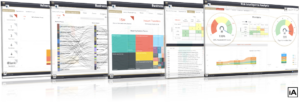
What [iB] BIA Insight Does
A structured, facilitated process that produces answers — not more questions.
[iB] BIA Insight replaces guesswork with evidence. Here's what the engagement delivers:
Scoping & Stakeholder Alignment
We define the business units, systems, and processes in scope and engage your executive sponsors from day one. No ambiguity about what's being analyzed or who owns the outcomes.
Facilitated Impact Workshops
iLLÜM runs cross-functional sessions with your business unit leads — the people who actually know what breaks when systems go down. We identify critical functions, map interdependencies, and surface the tribal knowledge that never makes it into documentation.
Financial Quantification
BIA Insight translates downtime scenarios into dollar-cost estimates. Lost revenue. Regulatory penalties. Operational cost. Reputational impact. Your leadership gets real numbers, not qualitative risk ratings.
RTO/RPO Development Recovery Time Objectives and Recovery Point Objectives for every critical system — grounded in business impact data, not IT preference.
Dependency Mapping People, technology, vendors, and facilities required to recover each critical function — mapped and documented. This is where single points of failure and undocumented vendor dependencies get found.
Board-Ready Deliverable The BIA is formatted for SOC 2, HIPAA, FFIEC, NAIC, and ISO 22301 audit requirements out of the box. No reformatting. No "translating" for compliance. It's ready.
Know what matters. Know what it costs. Know before you have to.
Who It's For
Built for the people, compliance and continuity actually fall on.
Your title: CEO, COO, CIO, CISO, CRO, VP of IT, VP of Operations, BCM/BCP Manager, Compliance Officer
Your organization: 100–2,500 employees. $50M–$2B revenue. Financial services, healthcare, manufacturing, or professional services.
Your situation:
- A compliance audit or regulatory examination is approaching and your BIA documentation has gaps
- A recent incident exposed that your DR plan doesn't reflect actual business priorities
- M&A due diligence requires documented business impact analysis
- Your last BIA is more than two years old and your environment has changed significantly
If your auditors have already asked for your BIA and you're not confident in what you'd hand them — that's exactly when to call.
What You Get
Results, not a project that stalls.
[iB] BIA Insight produces a single, comprehensive Business Impact Analysis that is:
Board-ready — formatted for executive presentation, not buried in a technical appendix
Compliance-formatted — structured to satisfy SOC 2, HIPAA, FFIEC, NAIC, and ISO 22301 requirements without additional reformatting
Financially quantified — downtime costs expressed in actual dollars, not red/yellow/green risk ratings
Integrated — BIA data flows directly into iLLÜM Risk Insight, creating a closed loop between your business impact analysis and your broader risk management program
Maintainable — designed for annual refresh, not to be filed away and forgotten This is the results your auditors are asking for. It's also the information your DR team needs to build recovery plans that reflect what actually matters to the business.
Customer Results
Regional Credit Union — NCUA Examination Readiness
A credit union facing an upcoming NCUA examination needed a current BIA to support their updated Business Continuity Plan. Their prior documentation was outdated and insufficient for examination requirements.
iLLÜM delivered a compliant, facilitated BIA in six weeks that satisfied NCUA examination requirements and identified three previously undocumented critical vendor dependencies — two of which were single points of failure that the credit union's existing DR plan did not address.
Multi-Site Engineering Firm — Enhanced ACAM / Critical Infrastructure
A multi-site telecommunications engineering firm, undergoing Enhanced ACAM Cyber Compliance, had no formal BIA documentation. The federal timeline left no room for a lengthy, internally managed effort.
[iB] BIA Insight produced a structured analysis across multiple business units, established RTOs and RPOs for 23 critical systems, and delivered audit-ready platform that is influencing daily business and IT decisions. Result: zero findings from the auditor on business continuity.
Multi-Site National Food Producer — Food Safety
A multi-site national food manufacturer facing increasing regulatory scrutiny and supply chain risk had no formal Business Impact Analysis (BIA) process in place. Production downtime, contamination events, cyber disruptions, or supplier failures could significantly impact food safety, compliance obligations, customer commitments, and revenue — yet leadership lacked documented recovery priorities and continuity metrics.
[iB] BIA Insight delivered a structured analysis across production, logistics, quality assurance, and IT operations; identified critical business processes and dependencies; established Recovery Time Objectives (RTOs) and Recovery Point Objectives (RPOs) for essential manufacturing and operational systems; and produced audit-ready continuity documentation within an accelerated timeline. Result: improved operational resilience, stronger compliance readiness, and a clear roadmap for maintaining safe food production during disruptions.
Ready to Close the Gap?
The question isn't whether you need a current BIA. Your auditors are already asking for it.
Here's what we'd ask in a 30-minute scoping call:
-
-
-
How old is your current BIA — and has anything changed in your systems, vendors, or processes since it was completed?
-
Does your DR plan actually reflect documented business impact priorities, or was it written independently by IT?
-
When your auditors last reviewed your BIA, were there findings — and are those resolved?
-
-
If any of those questions gave you pause, that's the conversation worth having.
[Schedule Your BIA Scoping Call]
[iB] BIA Insight is part of the iLLÜM Risk Platform. BIA data integrates directly with iLLÜM Risk Insight, Vulnerability Insight, Vendor, Third Party and Extended Enterprise Insight for continuous risk management.